What Is the Difference Between Advocate and Lawyer?
To Libra College of law
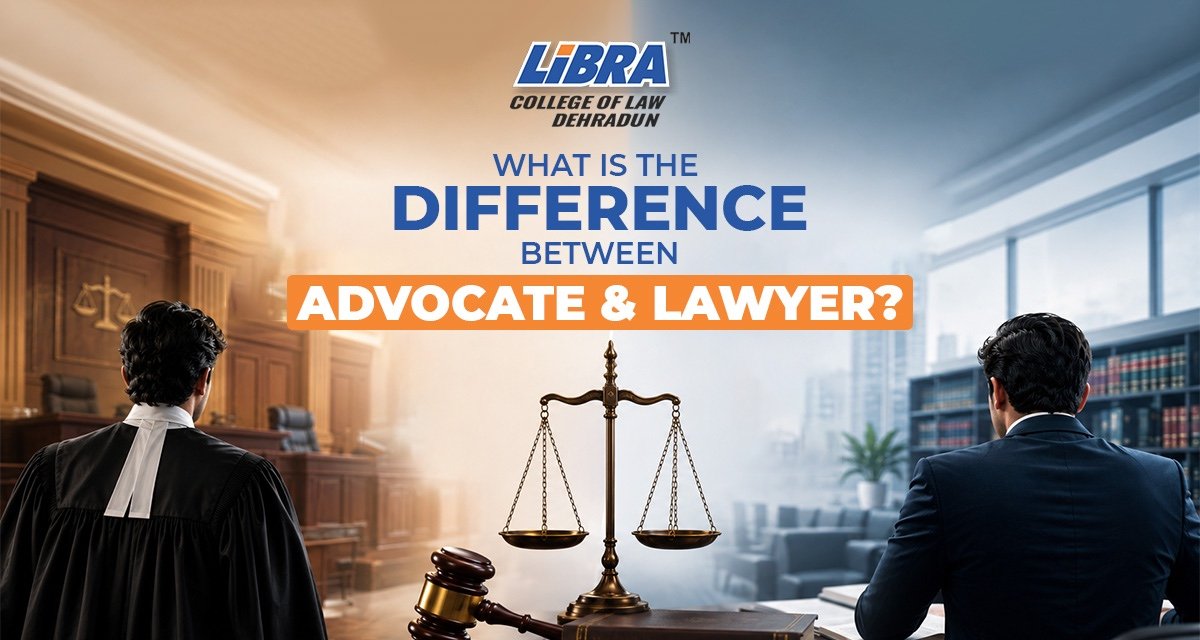
The difference between advocate and lawyer comes down to court practice rights. A lawyer is anyone with a law degree, while an advocate is a lawyer who has additionally enrolled with a State Bar Council and cleared the All India Bar Examination, giving them the legal right to represent clients and argue cases in court.
If you’ve ever heard someone use “advocate” and “lawyer” as if they mean the exact same thing, you’re not alone — most people do and honestly, in casual conversation it barely matters. But if you’re a law student or someone trying to figure out which path to take after a law degree, the advocate and lawyer difference actually matters quite a bit. It decides whether you can walk into a courtroom and argue a case or whether your work stays confined to advisory roles, contracts and legal documentation.
Let’s break this down properly because the confusion usually comes from the fact that both terms get thrown around loosely in everyday English even though Indian law treats them quite differently.
Who Is a Lawyer?
A lawyer, in the simplest sense, is anyone who has completed a recognized law degree — whether that’s a 3-year LLB after graduation or a 5-year integrated BA LLB straight after school. Having this degree qualifies you as a lawyer in the general sense of the word. You understand legal concepts, you can interpret statutes and you’re equipped to work in legal roles.
But here’s the catch: a law degree alone doesn’t automatically give you the right to stand up in court and represent someone. That’s where the second step comes in.
Who Is an Advocate?
An advocate is a lawyer who has taken one extra, mandatory step — enrolling with a State Bar Council under the Advocates Act, 1961 and then clearing the All India Bar Examination (AIBE) conducted by the Bar Council of India. Once this is done, they receive a Certificate of Practice and only then are they legally authorized to appear and argue on behalf of clients in courts across India.
So essentially, every advocate is a lawyer but not every lawyer is an advocate. It’s the same relationship as a square and a rectangle — one is a specific, more qualified version of the other.
Difference Between Advocate and Lawyer: A Quick Breakdown
To make this easier to digest, here’s how the two actually compare side by side:
Aspect | Lawyer | Advocate |
Basic qualification | Holds a recognized law degree (LLB or BA LLB) | Holds a law degree plus Bar Council enrollment and cleared AIBE |
Court representation | Cannot appear or argue in court | Can appear and argue on behalf of clients in court |
Certification required | Law degree only | Law degree plus Certificate of Practice from the Bar Council after clearing the AIBE |
Career scope | Can work as a legal advisor, in corporate legal teams, in research or in policy roles | Career is built specifically around litigation and courtroom practice |
Legal recognition | A general, umbrella term used worldwide | A legally defined designation under the Advocates Act, 1961 in India |
This is really the core of the difference between advocate and lawyer, and once you see it laid out this way, the confusion mostly clears up
Who Can Appear in Court - Advocate or Lawyer?
This is probably the most practical question students ask and the answer is straightforward — only advocates can appear in court. A person who holds a law degree but hasn’t enrolled with the Bar Council and cleared the AIBE simply doesn’t have the legal standing to represent a client before a judge. They might draft the petition, do the research or advise on strategy behind the scenes but the actual courtroom appearance has to be done by someone with active advocate status.
This is exactly why moot court practice during law school matters so much — it’s the closest students get to courtroom experience before they’re actually enrolled and certified to argue real cases.
Why This Distinction Matters for Law Students
If you’re currently studying law or planning to enroll in a program, this distinction should shape how you think about your career path, not just your vocabulary. A few things worth keeping in mind:
- Not everyone who studies law ends up in a courtroom and that’s completely fine — corporate law, legal research, policy work and judicial services are all valid, often lucrative paths that don’t require advocate status at all.
- If courtroom litigation is genuinely what excites you then you’ll need to plan for the AIBE and bar enrollment right from the start rather than treating it as an afterthought after graduation.
We’ve actually explored a related fork in the road in our blog on Judiciary vs Corporate Law: Which Career Is Right for You? which digs into how these different paths play out once you’re out of law school. It pairs well with this topic since both come down to understanding what different legal roles actually require.
And if you’re weighing your options even earlier — say, deciding between specializations after your degree — our post on Top Specializations to Consider After Completing Your Law Degree is worth a look too.
A Note for Aspiring Judges
Interestingly, becoming a judge actually requires advocate experience in most cases — candidates for judicial services typically need a few years of practice as an advocate before they’re eligible to sit for judiciary exams. If that’s the direction you’re eyeing, our detailed guide on How to Become a Judge in India After Completing LLB breaks down exactly how advocate practice fits into that journey.
Conclusion
So to sum it all up — the difference between advocate and lawyer really boils down to one extra qualification: Bar Council enrollment and clearing the AIBE. Every advocate starts out as a lawyer but only those who take this additional step earn the right to argue cases in court. Whether you end up as a courtroom advocate, a corporate legal advisor or eventually a judge, understanding this distinction early on helps you plan your legal career with much more clarity.
This is precisely the kind of foundational understanding Libra College of Law aims to build into its students from day one. With LLB, BA LLB and LLM programs running out of its Dehradun campus since 2006, the college structures its courses around real courtroom exposure — regular moot court sessions, seminars with practicing advocates and judges and a curriculum designed to prepare students for both litigation and non-litigation career paths. Whether a student’s goal is to become a practicing advocate, join the judiciary or move into corporate law, Libra College of Law’s blend of academic grounding and practical exposure gives them a genuine head start on whichever side of this advocate-lawyer line they choose to build their career.